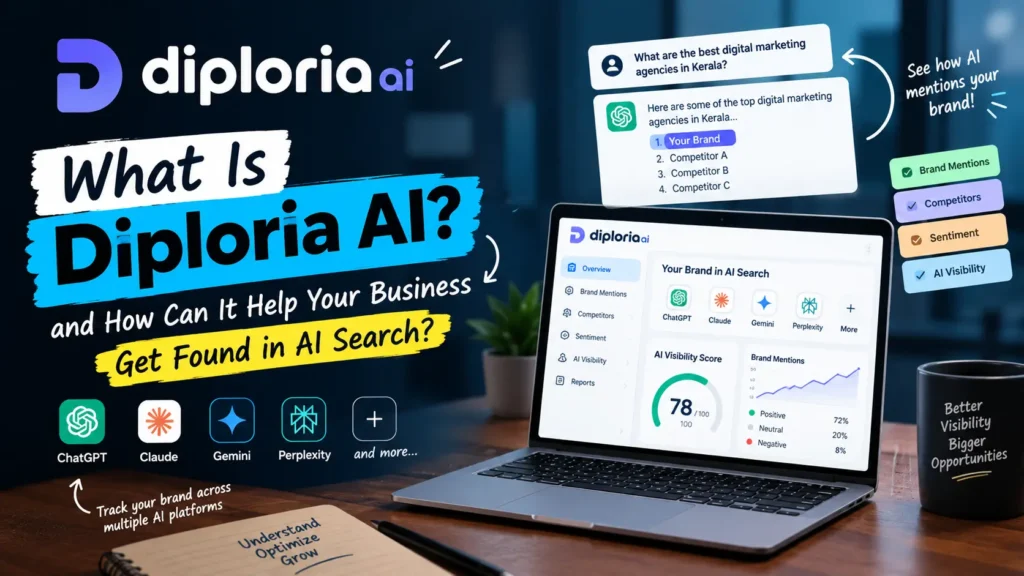
What Is Diploria AI and How Can It Help Your Business Get Found in AI Search?
Search is changing. Earlier, when people wanted to find a business, product, or service, they usually opened Google and checked the search results. Today, many people are also asking AI tools like ChatGPT, Claude, Gemini, and Perplexity for recommendations. This creates a new question for businesses: “Does AI know about my brand, and does it recommend me when people ask?” That is where Diploria AI comes in. What Is Diploria AI? Diploria AI is an AI visibility platform designed to help brands and agencies understand how their businesses appear in AI-generated answers. Instead of only looking at traditional Google rankings, Diploria checks how different AI engines describe, mention, and recommend a brand. In simple words, Diploria helps answer: “When customers ask AI about my industry, is my business showing up?” Why Is AI Visibility Becoming Important? Imagine someone asks ChatGPT: “What are the best digital marketing agencies in Kerala?” The AI may recommend several businesses. If your company is not mentioned, you may never even know that you were missing from that conversation. This is different from traditional SEO. With Google, you can look at your ranking and traffic. With AI search, understanding which brands are mentioned, which competitors appear, and what information AI uses can be much harder. Diploria is built to make this information easier to see. How Does Diploria AI Work? The process is fairly simple. First, you add your brand information, website, products or services, competitors, target audience, and the questions you want to track. Then, you select the AI engines you want to monitor. Diploria sends your selected prompts to the AI engines and records the responses. It can then show whether your brand was mentioned, how it was described, where it appeared, and what sources were cited. So instead of guessing what AI thinks about your brand, you can actually look at the answers. What Can You Track With Diploria? 1. Brand Mentions You can check how frequently AI mentions your business in relevant answers. This helps you understand whether your brand is appearing in conversations related to your industry. 2. Competitors You can add competitors and compare how different brands appear for similar questions. This can help you understand where your brand is visible and where competitors are getting more attention. 3. Sentiment Being mentioned isn’t always enough. AI might describe a brand positively, neutrally, or negatively. Tracking these changes can help marketers understand how their brand is being represented over time. 4. AI Visibility Score Diploria provides a visibility score that gives marketers a simple way to monitor changes in their brand’s presence across tracked AI responses. Instead of manually checking hundreds of answers, you can use the score as a quick reference point. What Is AI Visibility? AI visibility is basically about how easily your brand can be discovered and mentioned by AI systems when people ask relevant questions. For example, suppose you run a restaurant. People may ask: If AI regularly mentions your restaurant in relevant answers, your brand has stronger visibility in those conversations. Diploria helps you measure that visibility and identify gaps. Can Diploria Help With AEO and GEO? Yes. A major part of modern AI search focuses on Answer Engine Optimization (AEO) and Generative Engine Optimization (GEO). The idea is simple: instead of optimizing only for traditional search rankings, businesses also need to make their content easier for AI systems to understand and potentially reference. This means creating useful content, providing clear information about your business, building online authority, and making sure important information is easy to understand. Who Can Use Diploria AI? Diploria can be useful for different types of users. Small Businesses A small business can use it to understand whether AI assistants know about the brand and how the business appears in recommendations. Marketing Teams Marketing teams can monitor brand visibility across different AI platforms and identify content or visibility gaps. SEO Professionals SEO professionals can use the information alongside traditional SEO data to understand how their content performs in the growing AI search environment. Social Media & Digital Marketers For someone working as a best smm specialist in kerala, tools like Diploria can provide another way to understand how a brand is being discovered beyond traditional social media metrics. Digital Marketing Agencies Agencies can monitor multiple client brands, compare competitors, create reports, and track AI visibility over time. Is Diploria AI the Same as Google Search Console? No. Google Search Console is mainly focused on how a website performs in Google Search, including impressions, clicks, queries, and search performance. Diploria focuses on a different question: “What are AI platforms saying about my brand?” So they serve different purposes. For a modern marketing strategy, businesses may find value in looking at both traditional search data and AI visibility. Can Diploria Show What Sources AI Uses? Yes. One useful part of AI visibility tracking is understanding which websites and sources appear in AI-generated answers. This can give marketers a better idea of what type of content and sources are being referenced when AI talks about their industry. That information can be useful when planning content, digital PR, and authority-building activities. Does Diploria AI Have a Free Plan? Diploria offers a free option, along with paid plans that provide additional credits and features. Since pricing, features, and supported AI engines can change over time, it is always better to check the official Diploria website before choosing a plan. Is Diploria AI Worth Exploring? If your business depends on online visibility, it is becoming harder to look only at Google rankings. People are discovering information through AI assistants too. Diploria gives businesses a way to see what these AI systems are saying, which competitors are appearing, how often the brand is mentioned, and where there may be opportunities to improve. It doesn’t replace SEO, content marketing, or a good website. Instead, it adds another layer to your digital visibility strategy. Frequently Asked Questions What is Diploria AI used for? Diploria AI is used to track and